

A reflection on reframing grassroots football investment following the Kenya Academy of Sports Career Fair and Symposium, themed Exploring Diverse Career Opportunities in Sports. The author was on a panel with Sarah Bohner (Rep Worldwide), Peter Gacheru (IMG Kenya), Mohamed El Badry (Korastats) and Collins Were (Kenya Private Sector Alliance), discussing Commercialisation, Media and Marketing in Sports
At the recent Kenya Academy of Sports Career Fair and Symposium, a familiar debate emerged during our panel discussion. As someone who has long advocated for private sector investment in grassroots football, I found myself face-to-face with a hard truth delivered by my fellow panellists: “Corporations don’t love sports, and they won’t give money out of pity.”
The statement hung in the air with uncomfortable honesty. My instinct was to push back, to argue that businesses have a responsibility to invest in community development, that grassroots sports deserve support as a matter of corporate social duty. Instead, I took a softer approach, suggesting that African corporates should engage in dialogue with grassroots football organisations to explore co-creation opportunities.
But as I left the conference, their words lingered. If corporates won’t invest out of pity, and even appeals to responsibility fall short, then what? The question that kept surfacing was fundamental: Who should invest in grassroots football?
The answer, I realised, lies not in changing who we ask, but in changing what we’re asking for.

The Problem with Product Positioning
Across Africa and much of the world, football is everywhere. From dusty pitches in villages to packed stadiums in cities, it draws people in with a magnetic force. But despite its popularity and influence, football is still too often seen in narrow terms—as entertainment, a commercial product, or a professional sport for the talented few.
This narrow view is precisely what creates the funding dilemma we face. When we present grassroots football as a product seeking buyers, we inevitably encounter the market reality my fellow panellists described. Corporations evaluate products based on direct returns, brand visibility, and commercial viability. Grassroots football, by definition, often struggles to demonstrate immediate commercial returns in the traditional sense.
Even when we pivot to positioning sports as education—a common advocacy approach—we run into the same challenge. While corporates may support education through CSR programs, they typically do not view it as core infrastructure requiring substantial, sustained investment. Education, like sports, often gets categorised as a “worthy cause” rather than fundamental infrastructure.
We need to change that view entirely.
Football As Infrastructure: A Strategic Reframe
Football is not just a business. It is not merely a game. Football is infrastructure. It is a platform that, when fully understood and strategically developed, can enable progress in education, health, employment, innovation, and community development. In short, football is an ecosystem enabler—and it should be treated as such in national development strategies, private sector investments, and community programs.
Like roads, energy, and digital networks, football enables movement—not of goods or data, but of opportunity. It connects individuals, communities, and industries across boundaries and generations. Its influence touches formal sectors and informal economies, government agendas and grassroots movements, cultural identity and global diplomacy.
Consider the evidence: Football drives economic activity not only in professional leagues, but in media, tourism, merchandising, logistics, and technology. It contributes to social cohesion, bringing people together across ethnic, political, and class lines. It promotes health and well-being, from organised youth programs to casual weekend games. Football fosters lifelong learning—teaching discipline, leadership, resilience, and collaboration. These qualities are valuable not only in sport, but in life and work.
At the same time, football drives investment in infrastructure, from stadiums to training centres to digital platforms. It fuels innovation in data analytics, event management, and broadcasting. It becomes a tool for diplomacy, a stage for cultural expression, and a medium for youth engagement. The ripple effects are broad and long-lasting—if we choose to harness them.
The Anchor Tenant Analogy
To explain this infrastructure concept further, I often use the analogy of a shopping mall. In every thriving mall, there’s an anchor tenant—the big-name store that draws the crowds. That anchor drives foot traffic, makes the mall more attractive to investors, and helps smaller businesses thrive. The mall developer invests heavily in securing and supporting that anchor tenant not out of charity, but because it’s foundational to the entire ecosystem’s success.
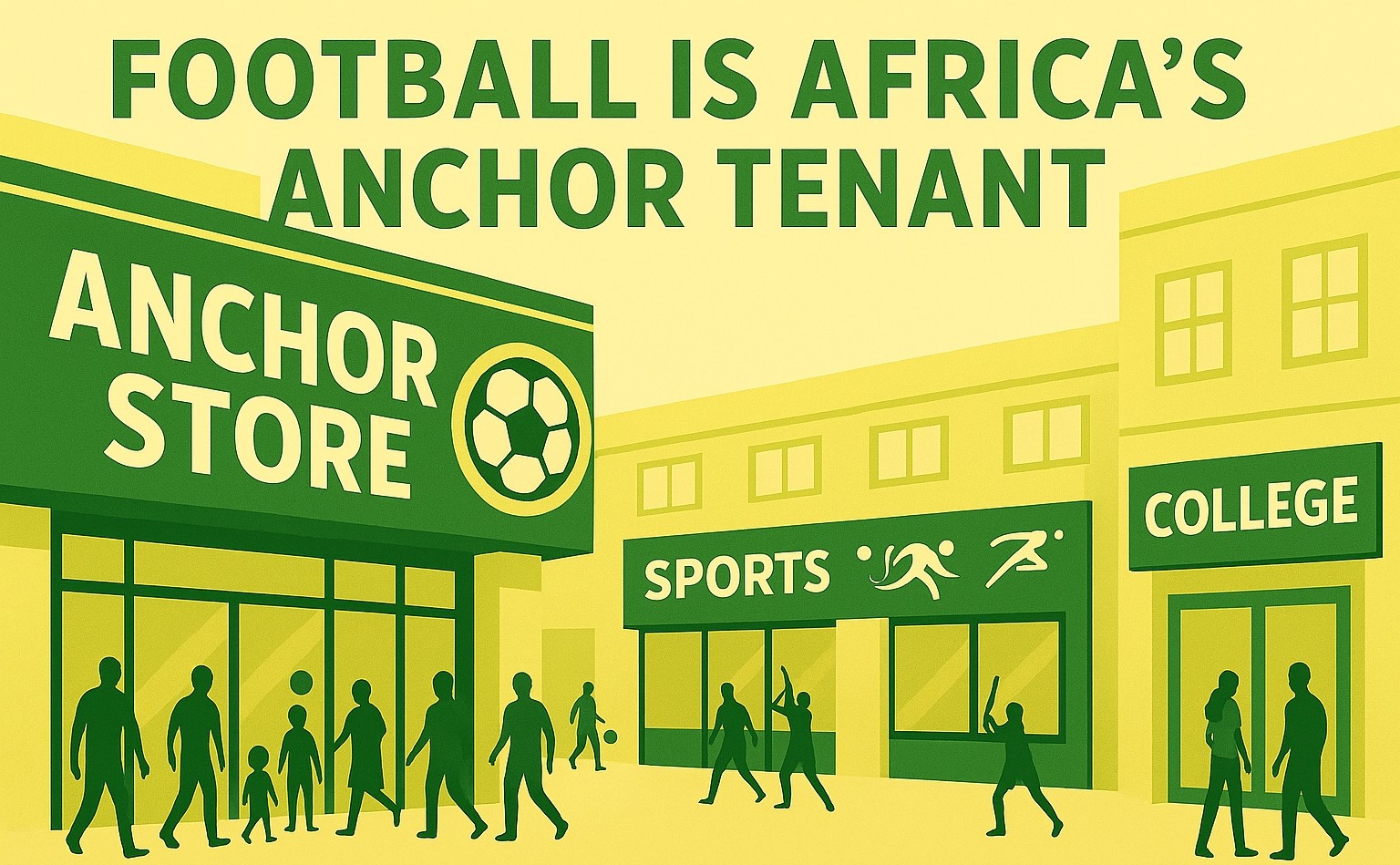
In Africa’s sports and development ecosystem, football is the anchor tenant. It is the sport that attracts the most attention, engagement, and resources. By building robust systems around football—in infrastructure, education, governance, and innovation—we create an environment that can uplift all sports and other adjacent sectors. The stronger the football ecosystem, the more vibrant the entire “mall” becomes.
This is why competent developers invest in anchor tenants, and why strategic governments should invest in football infrastructure.
Government As the Primary Investor: A Logical Conclusion
The conference discussion led me to a crucial realisation: if we’re serious about treating football as ecosystem infrastructure, then government becomes the logical primary investor. This isn’t about sports policy—it’s about national development strategy.
Governments routinely invest in infrastructure—roads, energy grids, digital networks, ports, airports—not because these sectors lobby for sympathy, but because they’re recognised as foundational to economic growth and social development. These investments are evaluated based on their multiplier effects, their ability to enable other sectors to thrive, and their contribution to national competitiveness.
Football infrastructure deserves the same treatment and justification. This approach aligns perfectly with the African Union’s Agenda 2063, which emphasises youth empowerment, economic transformation, and building the infrastructure needed for Africa’s development. When we view football through the Football as Infrastructure (FaI) Model lens, it becomes a strategic tool for achieving multiple Agenda 2063 aspirations simultaneously—from “Silencing the Guns” through youth engagement to building “World Class Infrastructure” that serves broader development objectives.
When governments invest in roads, they’re not primarily thinking about the road construction industry. They’re considering how better roads can facilitate commerce, lower transport costs, connect communities, and attract investment. Similarly, when governments invest in football infrastructure, they shouldn’t be thinking primarily about sports. They should consider how robust football systems facilitate education delivery, health promotion, youth engagement, social cohesion, and economic activity.
The Multiplier Effect in Practice
Let’s examine what this looks like in practical terms. A government that invests in comprehensive football infrastructure—quality pitches, training facilities, coaching education, youth programs, and governance systems—creates a foundation that amplifies investments across multiple sectors:
Education: Football programs become vehicles for keeping children in school, teaching life skills, and creating pathways to higher education through sports scholarships and academy systems.
Health: Regular football activities address rising obesity rates, mental health challenges, and lifestyle diseases while building a culture of physical activity that reduces long-term healthcare costs.
Employment: A robust football ecosystem creates jobs not just for players and coaches, but for groundskeepers, equipment suppliers, event managers, sports journalists, physiotherapists, administrators, and countless other support roles.
Innovation: Football drives demand for sports technology, data analytics, broadcasting solutions, and facility management systems, spurring local innovation and attracting international partnerships.
Tourism and Hospitality: Quality football infrastructure attracts tournaments, training camps, and sports tourism, benefiting hotels, restaurants, transport operators, and local businesses.
Social Cohesion: Football programs provide positive engagement opportunities for at-risk youth, create cross-community connections, and offer platforms for addressing social challenges.
International Relations: Strong football infrastructure enhances a country’s ability to host international events, engage in sports diplomacy, and build cultural connections globally.

This multiplier effect is precisely why football infrastructure deserves government investment—not as a favour to sports, but as a strategic enabler of broader national development.
Beyond Government: Strategic Private Sector Partnership
While the government should be the primary investor in football infrastructure, this doesn’t eliminate the role of private sector engagement. Instead, it transforms the nature of that engagement from charity to strategic partnership.
When corporations invest alongside robust government football infrastructure, they’re not funding sports out of pity—they’re investing in platforms that amplify their other business objectives. A company investing in education finds that football programs increase engagement and retention. A health-focused business discovers that football initiatives extend their reach into communities. A technology company realises that sports platforms offer ideal testing grounds for innovation.
Furthermore, the FaI Model creates ideal conditions for Public-Private Partnerships (PPPs) that reduce the burden on government budgets while leveraging private sector efficiency and innovation. Just as governments partner with private companies to build roads, airports, and energy infrastructure, football infrastructure can be developed through PPP models where private partners bring capital, expertise, and operational efficiency. In contrast, the government ensures strategic alignment with national development objectives.
The key difference is sequence and framing. Government establishes the foundational infrastructure; private sector partners invest in specific programs, innovations, or enhancements that align with their business objectives while contributing to the broader ecosystem.
A Call for Strategic Thinking
The conference exchange that sparked this reflection highlights a critical need for strategic thinking about sports investment in Africa. We must stop positioning grassroots football as a product seeking buyers or even as a worthy cause seeking sponsors. Instead, we must recognise and articulate football’s role as foundational infrastructure that enables broader development outcomes.
This reframing has implications for how we approach different stakeholders:
For Government Leaders: Football infrastructure investment should be evaluated alongside other infrastructure priorities using similar criteria—economic multiplier effects, social impact, and strategic national benefits. The question isn’t whether the government can afford to invest in football; it’s whether the government can afford not to invest in such a powerful enabler of multiple development objectives.
For Private Sector Partners: The opportunity isn’t charity or even CSR—it’s a strategic partnership with established infrastructure that amplifies business impact across education, health, community engagement, and innovation initiatives.
For Development Organisations: Football represents a platform for delivering programs more effectively, reaching target populations more efficiently, and achieving outcomes more sustainably than traditional approaches.
For Sports Organisations: The focus shifts from seeking support for football to demonstrating football’s support for broader societal objectives.
Implementation: Where Do We Start?
Recognising football as ecosystem infrastructure is the first step; building systems that harness this potential is the next. This requires:
- Policy Integration: Incorporating football infrastructure into national development plans, not just sports policies.
- Cross-Sector Collaboration: Bringing together education, health, employment, and community development stakeholders around football platforms.
- Measurement Systems: Developing metrics that capture football’s broader impact beyond traditional sports indicators.
- Investment Frameworks: Creating funding mechanisms that reflect football’s infrastructure role rather than its entertainment value.
- Institutional Capacity: Building organisations capable of managing football as a development platform, not just a sporting activity.
The Path Forward
The honest exchange at the Kenya Academy of Sports Career Fair prompted a necessary reassessment of how we position grassroots football investment. The panellists were right—corporates won’t invest out of pity, and appeals to responsibility have limited power. But they were operating within a framework that sees football as a product rather than infrastructure.
When we shift to viewing football as ecosystem infrastructure, we’re not asking for charity or appealing to corporate conscience. We’re presenting a strategic investment opportunity in foundational systems that enable multiple sectors and objectives to thrive.
Football is not the end goal. It is a vehicle. A stage. A connector. A builder.
Government should lead this investment not because sports deserve support, but because societies deserve the infrastructure that enables opportunity, connection, and progress. The private sector should engage not out of obligation, but because robust football infrastructure amplifies their other investments and objectives.
And when we get this right, we don’t just elevate the game—we elevate people, communities, and nations.
The conversation continues, but the framing has fundamentally changed. Football isn’t seeking investment—football is offering to be the infrastructure that makes other investments more successful.
That’s a conversation worth having.
Join the Movement: From Concept to Continental Implementation
The FaI Model represents more than just a new way of thinking about football—it’s a call to action for everyone who believes in Africa’s potential to lead innovative development solutions.
If you’re a government official, development practitioner, academic, business leader, or sports stakeholder who sees the transformative potential of this approach, we want to hear from you. The Football Foundation for Africa is actively seeking partners to pilot FaI Model implementations, conduct research validation, and develop policy frameworks.
This conversation will continue at the Africa Football Business Summit, where leaders from across the continent will gather under the theme “Building Africa’s Football Future: Investment, Governance and Grassroots Excellence.” This is where The FaI Model moves from concept to action—where we’ll explore practical implementation pathways, discuss policy implications, and build the partnerships needed to transform African football development.

The Summit represents the perfect opportunity to engage with fellow innovators, share experiences, and contribute to shaping how Africa approaches sports as strategic infrastructure. Whether you’re ready to pilot The FaI Model in your context or simply want to be part of redefining Africa’s football future, your voice matters in this movement.
Contact the Football Foundation for Africa to explore partnerships, share your insights, or learn more about implementing The FaI Model in your context. Together, we can transform football from product to infrastructure, from extraction to empowerment, from charity case to continental asset.
The infrastructure has been there all along. Now it’s time to build on it strategically.
 Back to Blog